

In the high intramuscular fat protein segment, the comparison between Ibérico pork and Japanese Wagyu beef has moved beyond gastronomic curiosity into strategic sourcing territory. While Wagyu remains the global benchmark in luxury beef, 100% Ibérico — specifically Bellota grade — has established itself as the "Wagyu of pork": a portfolio asset that combines exceptional intramuscular marbling with a cost structure that Japanese beef simply cannot match. For a food broker or HORECA purchasing director, the sourcing decision hinges on three pillars: lipid chemistry, food cost scalability, and regulatory transparency across the supply chain.
The Biology of Infiltration: IMF Indices and Fatty Acid Profiles
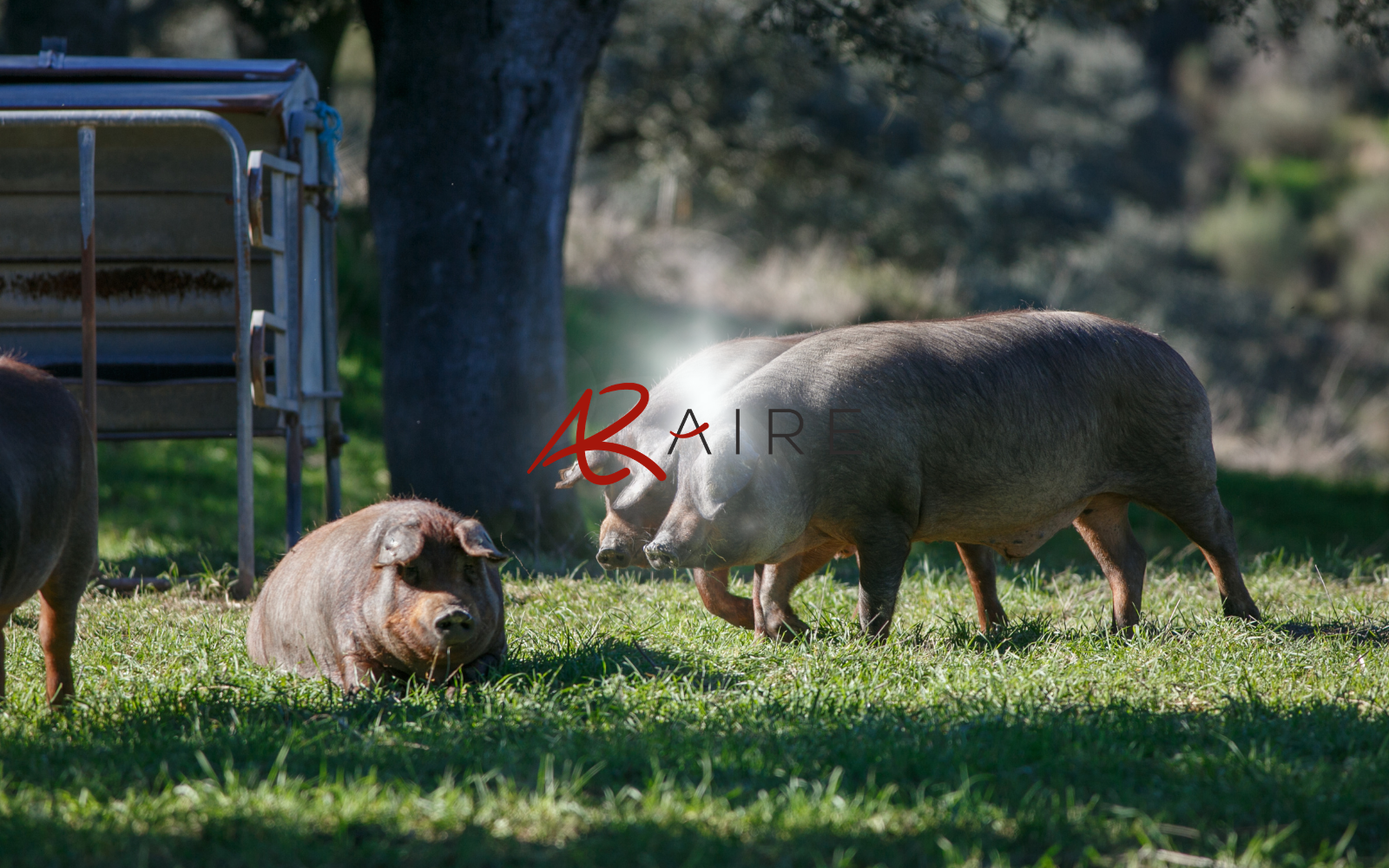
Both proteins derive their prestige from Intramuscular Fat (IMF), yet the metabolic pathways that generate it are fundamentally different. Japanese Black Wagyu relies on intensive grain-finishing protocols of up to 30 months — and average carcass weights of 470–490 kg — to develop its signature A5 marbling. The 100% Ibérico pig, by contrast, carries a unique genetic trait within its lineage: the ability to infiltrate monounsaturated fatty acids (MUFAs) directly into muscle fibres while roaming the Dehesa during the Montanera season.
The Metabolic Advantage of Oleic Acid
Wagyu fat is predominantly rich in stearic acid (C18:0, saturated). Bellota Ibérico fat is composed of more than 55% Oleic Acid (C18:1) — the same monounsaturated fatty acid that defines extra virgin olive oil. For a purchasing decision, this has two direct consequences. First: Ibérico fat has a melting point of approximately 24°C, versus ~32°C for A5 Wagyu. The fat begins to "self-baste" the cut at room temperature, delivering a cleaner, lighter mouthfeel and a higher portion tolerance — critical for engineering 300–400g main course dishes without compromising the dining experience. Second: Ibérico Bellota's fatty acid profile aligns with expanding nutritional trends across key European retail markets — Germany, France, the Netherlands — strengthening the nutritional positioning argument for buyers serving health-conscious end consumers.
Genetic Marbling vs. Induced Marbling
Wagyu A5 marbling is the result of a controlled feeding protocol. Ibérico intramuscular marbling is the outcome of breed-specific genetic selection and the animal's physical activity during the Montanera: a process that cannot be industrially replicated. For an importer managing provenance attributes with premium buyers, the distinction is strategically significant — Ibérico Bellota carries an authenticity narrative backed by geographic traceability and genetic lineage that Wagyu produced outside Japan cannot credibly claim.
B2B Benchmark: Japanese Wagyu A5 vs. 100% Bellota Ibérico Pork
| Technical Metric | Japanese Wagyu A5 | 100% Bellota Ibérico |
|---|---|---|
| Fatty Acid Profile | Predominantly Stearic / Saturated (C18:0) | Predominantly Oleic / MUFA (C18:1, >55%). High-oleic profile driven by the acorn diet during Montanera — comparable to olive oil. |
| Fat Melting Point | ~32°C. Remains firm at room temperature; renders on the plate during service. | ~24°C. Fat begins to soften near room temperature. Renders quickly on the grill; requires a narrower cooking window, especially in Bellota-grade cuts. |
| Origin of Marbling | Induced via intensive grain-finishing in controlled feedlot conditions. | Genetic lineage (Ibérico breed) + free-range Dehesa activity and acorn feeding during Montanera. Marbling is earned, not induced. |
| Carcass Yield | High — steak-format dominant. Limited cut diversity beyond the premium loins. | High — multiple technical fresh cuts (Presa, Secreto, Pluma, Abanico, Carrillera, ribs, belly) plus cured by-products (Jamón, Lomo, Salchichón). Full-carcass monetisation is viable. |
| Food Cost Ratio | Critical — import prices in European markets frequently exceed €350–400/kg. Viable only as a niche or tasting-menu item at most operations. | Scalable — price architecture supports 70–75% contribution margins in competitive HORECA environments. Viable as a menu anchor, not just a niche item. |
| Export Regulatory Framework | BMS System (1–12) — private grading standard, complex external classification with no single legally binding EU framework. | Royal Decree 4/2014 — legally guaranteed traceability via the ÍTACA national database. Color-coded seals (Black / Red / Green / White) confirm grade and breed percentage at slaughter. |
Economic Scalability: Food Cost, Plate Margin and Average Ticket Potential
The Luxury Threshold: Where Wagyu Stops Scaling
For a national distributor, the core challenge of Wagyu A5 is the plate cost barrier. Import prices in European markets frequently exceed €350–400/kg, confining its use to miniature appetisers or high-friction tasting menu formats where the price per serving can absorb the acquisition cost. From the perspective of a HORECA purchasing director, this translates Wagyu into a low-rotation product line with high stock management complexity, significant inventory lock-up risk, and a limited ability to anchor a menu section or drive consistent weekly revenue. The product demands exceptional front-of-house execution to justify the plate cost to diners — a dependency that makes it fragile outside a narrow tier of fine-dining operations.
Ibérico as a Margin Driver on the Menu
Bellota Ibérico Pork bridges the gap between commodity pork and ultra-luxury beef. Its price architecture allows HORECA clients to deliver a world-class marbled protein experience in 300–400g main courses while maintaining contribution margins of 70–75% in competitive restaurant environments. Cuts such as the Presa Ibérica and the Secreto generate the visual marbling impact of a Wagyu steak in the dining room — at an acquisition cost that makes them viable as a permanent menu anchor rather than a niche or seasonal item. The Secreto in particular, with the highest intramuscular fat infiltration of any fresh Ibérico cut, delivers the kind of tableside drama — fat rendering visibly on a hot cast-iron plate, intense aroma, pronounced texture — that drives social media traction and repeat orders. For cut-specific food cost projections at your target volumes, contact the AIRE technical team directly.
Procurement Insight: Unlike Wagyu — essentially a single-format steak product with limited kitchen versatility — the Ibérico portfolio integrates high-infiltration fresh cuts, long-cycle cured charcuterie (Jamón, Lomo, Salchichón), and technical lard with multiple kitchen and butchery applications. For an importer or distributor, this means consolidating premium protein spend under a single, highly efficient supply chain — reducing active supplier count, simplifying cold chain logistics, and opening cross-selling opportunities across restaurant, retail, and deli segments from one sourcing relationship.
Inventory Turnover and Purchase Risk Management
Ibérico turnover rates in mature European markets (France, Germany, the Netherlands) consistently outperform imported Wagyu in the intermediary distribution segment. The lower price per kg expands the reachable customer base substantially: casual-premium restaurants, premium supermarkets, specialty butchers, and online retail channels that would never qualify as Wagyu accounts are natural Ibérico buyers. This enables higher-volume orders and more frequent replenishment cycles, reducing inventory lock-up risk and improving stock liquidity ratios across the portfolio. For a broker managing a mixed premium protein range, Ibérico functions as a cash flow stabiliser against the high price volatility inherent in imported Japanese beef — a product whose landed cost can shift materially with currency movements, logistics disruptions, or changes in Japanese export policy.
Origin Logistics and Export Compliance: Salamanca vs. Japan
Comparative Regulatory Complexity
Navigating the Japanese BMS classification system (1–12) requires either in-house specialisation or local intermediaries at additional cost. The system is privately administered and lacks a single legally binding EU-recognised framework, which means importers must invest in additional due diligence and supplier verification at every transaction. Spain's Royal Decree 4/2014, by contrast, establishes a colour-coded tag system — Black, Red, Green, and White — that guarantees breed purity grade and feeding system with full documentary traceability enforced at national level through the ÍTACA database. For a compliance department in modern retail or an importer subject to supply chain audits, the operational difference is material: Ibérico can be justified before any inspector or end buyer with standard documentation recognised across the entire EU, without reliance on third-party grading bodies or private certification schemes.
Direct Supply from the Dehesa: Eliminating Intermediation
The advantage of sourcing through AIRE Ibérico Meat in Salamanca is the elimination of the broker layers standard in the Ibérico export market. Where the channel from a Japanese Wagyu producer to a European importer typically runs through three or four intermediary levels — each adding cost, lead time, and documentary complexity — AIRE provides direct access from the productive heart of the Salamanca Dehesa. Our logistics infrastructure ensures full compliance with BRC and IFS certifications with complete lot traceability, delivering the supply chain transparency that international retail compliance protocols increasingly demand. BRC and IFS certifications are not merely market entry requirements for Anglo-Saxon and Central European buyers: they are the operational guarantee that protects the importer against any audit contingency, recall event, or regulatory challenge downstream. AIRE manages this process end-to-end, from slaughter documentation to export paperwork, so that your team does not need to.
To verify certification availability for specific destination markets — USDA, APHIS, BRC AA, IFS Food Higher Level — contact our export department before issuing a purchase order.
Optimise Your Premium Protein Portfolio
Food cost should not be the ceiling on your marbled protein offer. Connect directly with the AIRE export team to receive wholesale pricing, cut availability, and logistics terms tailored to your destination market.
Strategic B2B Ibérico Procurement
Is Ibérico pork as profitable as Wagyu for a national distributor?
In most European markets, Ibérico delivers a significantly higher inventory turnover rate than imported Wagyu A5. Its lower price per kg broadens the reachable customer segment substantially within HORECA and retail channels — casual-premium restaurants, specialty butchers, premium supermarkets, and online food retail are all viable accounts for Ibérico, whereas A5 Wagyu is confined to a much narrower fine-dining tier. This expanded customer base enables higher-volume orders and more frequent replenishment cycles, reducing inventory lock-up risk and improving stock liquidity across the portfolio. The net result, for most distributors operating in mature European markets, is stronger gross margin-on-stock performance compared to imported Japanese ultra-luxury beef — where high acquisition cost and low rotation create a structurally more fragile business case.
Can I secure a continuous supply of Bellota grade outside the Montanera season?
Although the Montanera is seasonal — running from October through February, when Ibérico pigs feed on acorns and natural pasture in the Dehesa — AIRE operates IQF (Individual Quick Freezing) facilities in Salamanca that allow us to lock in peak winter-harvest quality and supply international partners consistently across all twelve months of the year. IQF freezing preserves the lipid profile and intramuscular fat structure of the cut by preventing the formation of large ice crystals that would otherwise degrade the marbling. It is the sector's reference method for long-distance export of premium Ibérico, and the format preferred by HORECA buyers and importers who require year-round availability with predictable specifications. Fresh (chilled) availability is subject to seasonal production cycles and should be confirmed with our export team for each order window.
How do you manage export compliance for markets such as the US, Asia, and the UK?
The Ibérico industry operates under strict EU animal welfare and food safety regulations, with additional certification requirements per destination market that vary significantly in scope and complexity. AIRE manages USDA/APHIS health certificates for the United States, TRACES documentation for third-country exports from the EU, and the specific labelling and veterinary documentation required by customs authorities in Asia and the post-Brexit United Kingdom — all handled in-house by our export compliance team. Our objective is to ensure your containers clear customs without delays or documentary incidents, and to absorb the regulatory complexity that would otherwise require your team to maintain specialist knowledge across multiple jurisdictions. Contact our export department before issuing a purchase order to confirm current certification status for your specific destination market.
What distinguishes Ibérico Bellota from other Ibérico grades in terms of IMF?
Bellota grade — Black tag for 100% racial purity, Red tag for 75% or 50% Ibérico — is distinguished from Ibérico de Cebo de Campo and standard Cebo precisely by the intensity of intramuscular fat infiltration achieved during the Montanera. The animal's sustained physical activity across the open Dehesa and its exclusive acorn diet during this period generate a measurably higher IMF index and an oleic acid profile that feeding-based grades cannot replicate, even when starting from the same breed and slaughter weight. This difference is not cosmetic: it affects the fat's melting point, its oxidation behaviour during storage, its cooking performance on the grill, and the flavour complexity perceived at the table. For a procurement team evaluating Ibérico grades against specific menu or retail positioning, the Bellota–Cebo distinction is the primary technical variable to assess before fixing a sourcing decision.